

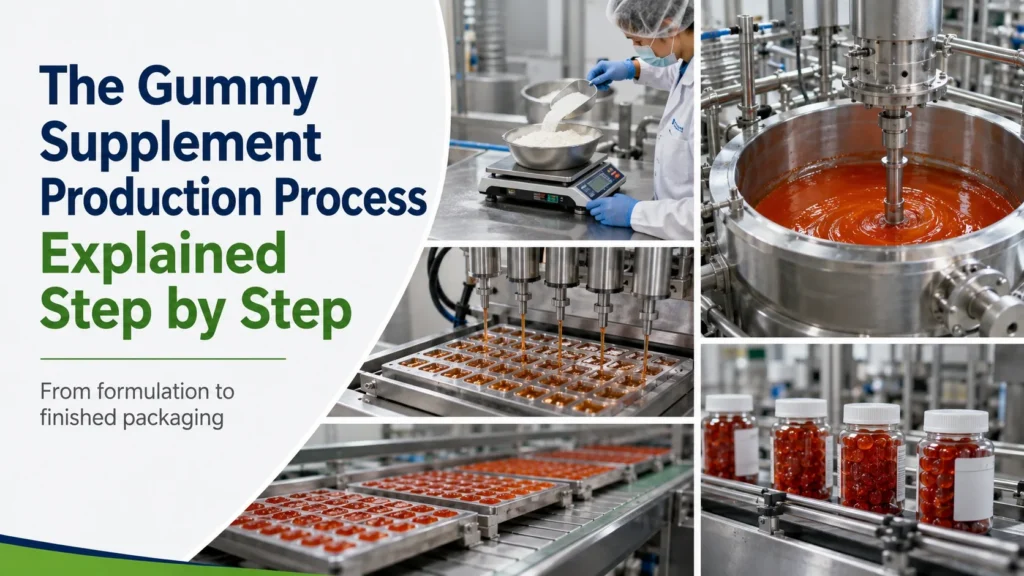
A finished bottle of gummy supplements looks deceptively simple. Peel off the label and you’d never guess that what’s inside went through roughly 11 to 12 precision-controlled stages to produce. Understanding the gummy supplement production process is what separates a product that clears QC with clean documentation from one that never makes it out of the facility. At Nutropac, we walk every brand partner through the full production workflow before the first batch runs, because that knowledge changes every conversation that follows. This article covers that same sequence, from the formulation decisions made before production starts to the sealed, labeled bottle ready for retailer shelves.
Whether you’re evaluating your first gummy SKU or troubleshooting an existing line, knowing what actually happens on the production floor changes how you evaluate manufacturing partners and manage risk. Here’s how gummy supplements are made, stage by stage.
Formulation and base selection: where every gummy production process starts
The first decision in any gummy development project is the gelling system, and it shapes nearly every downstream process parameter. The two dominant options are gelatin and pectin, and they are not interchangeable. Gelatin, used at roughly 5, 10% of the formula, produces the classic elastic, chewy texture most consumers recognize. Pectin, typically used at 1, 5%, gives a shorter, cleaner bite and is the required base for vegan products. Gelatin gels thermally, meaning it sets as it cools. Pectin requires both sugar and acid to form a stable gel, which means the cooking sequence and pH management look completely different, and that makes it a decision you cannot revisit mid-production.
This one formulation decision ripples through equipment settings, cooking temperatures, depositor behavior, and coating requirements later in the line. Beyond the gelling agent, the formula is built with glucose syrup to prevent crystallization and control stickiness, sugar for bulk and solids content, water as a processing vehicle that gets largely cooked out, and citric acid for flavor and, in pectin systems, as a gelation trigger.
Heat-sensitive actives, certain vitamins, probiotics, or botanical extracts, are added after the base is cooked and has cooled to a safe holding temperature. The sequence matters because adding a heat-labile ingredient too early destroys potency before the gummy is ever molded.
Before full-scale production begins, the formula goes through pilot batches. Taste, texture, and color are evaluated alongside initial stability data, and dosage accuracy per gummy is confirmed against the target label claim. Issues with uniformity, stickiness, or color fading are far cheaper to catch at the prototype stage than during a full commercial run. This validation step is non-negotiable for any compliant gummy manufacturing process.
Cooking, mixing, and depositing: the core of gummy vitamin production
Once the formula is locked, the gummy production process begins with cooking. The gelling agent is hydrated and dissolved into the sweetener system, then brought to temperature in a steam-jacketed kettle or continuous cooker.
Gelatin systems
Gelatin systems are typically cooked to around 215, 225°F (102, 107°C) to fully hydrate the protein without denaturing it. If temperatures deviate even modestly, the consequences range from incomplete hydration to gel failure.
Pectin systems
Pectin systems run hotter, often reaching 112, 120°C, with precise pH control throughout to prevent the gel from setting prematurely inside the gummy manufacturing equipment. Deviations here can cause the entire mass to seize in the line.
After cooking, heat-sensitive nutrients, natural colors, and flavors are blended in once the base has reached a safe holding temperature. This step requires thorough, uniform mixing. Any inconsistency in active ingredient distribution shows up directly in potency results on the finished gummy’s Certificate of Analysis. Dose accuracy at this stage is not recoverable downstream. What goes into the mass is what comes out in the mold.
Depositing is where the liquid gummy mass moves from the kettle to the mold. The mass is pumped into a depositor that fills individual cavities in a mold tray at a controlled rate and volume. Depositor accuracy determines per-gummy weight consistency across the entire batch, which is the physical basis for meeting label claims. Depositors on a commercial gummy production line are sized by throughput and cavity output, and the temperature of the mass at the point of deposit affects how cleanly it fills each cavity and what the surface quality looks like after setting.
Cooling, demolding, drying, and coating
After depositing, filled mold trays move through a cooling tunnel where the gummy mass sets into its final shape. The cooling rate and tunnel temperature determine gel firmness, clarity, and surface texture. Uneven cooling causes shape defects or mold adhesion, both of which raise scrap rates. Large-scale operations use controlled-temperature tunnels; smaller pilot runs may use refrigerated rooms, though consistency is harder to maintain at that scale.
Once demolded, gummies enter the drying or conditioning phase. In our experience, this is the step most often underestimated in early-stage gummy development, and it is one of the most common root causes of shelf-life failures. The goal is to reduce excess moisture to a target water activity below 0.65 aw, with most commercial formulas targeting 0.50, 0.60 aw for stability. Drying typically runs 24 to 72 hours in climate-controlled rooms with managed airflow. Gummies that exit drying with too much residual moisture will stick together in the bottle, develop surface tackiness, and become vulnerable to microbial growth during their shelf life. There is no shortcut to this stage without paying for it later.
After drying, gummies receive a surface treatment. The two most common options are carnauba wax polishing, which provides a strong moisture barrier and a smooth, glossy finish, and sugar sanding, which creates a crystalline exterior that reduces stickiness while adding a sweet, sparkly appearance. Oil-based finishes offer a simpler anti-stick solution with less visual polish. Coating is not cosmetic. It directly affects pour quality from the bottle, stickiness complaints from consumers, and moisture protection for sensitive active ingredients throughout the product’s shelf life.

Quality control and compliance checkpoints
Under FDA’s dietary supplement cGMP regulations at 21 CFR partie 111, manufacturers are legally responsible for verifying the identity, purity, strength, and composition of every finished batch. For gummies, that means potency testing to confirm active ingredient levels match label declarations, microbial testing for contamination control, moisture and water activity measurement, and physical inspection for weight uniformity, shape, and color. Finished-product testing is not optional; it is the line between a compliant batch and a regulatory liability. FDA does not set universal numeric microbial limits for gummies specifically; instead, manufacturers must establish their own scientifically justified finished-product specifications and test to those specs before any batch ships.
Every batch that ships from Nutropac comes with full documentation: a Certificate of Analysis covering tested parameters, results, analytical methods, and pass/fail criteria, alongside complete batch records with lot coding for traceability. If a recall or consumer complaint ever surfaces, traceability back to raw material lot numbers is what keeps a brand protected.
This level of documentation also accelerates retailer onboarding, supports third-party audits, and puts brands in a defensible position during FDA inspections. It is not paperwork for its own sake; it is the infrastructure that makes scaling a supplement brand possible.
Packaging, labeling, and shelf-life readiness
Once gummies clear QC, they move to the packaging line, where they are counted or weighed into bottles, pouches, or sample packs, then sealed with induction liners, capped, and labeled. Inline checkweighers and metal detectors are standard at this stage. Package selection matters beyond aesthetics: in many cases, HDPE bottles with induction seals provide stronger moisture protection than stand-up pouches, depending on pouch barrier properties and intended shelf life, a meaningful consideration for products containing hygroscopic actives or probiotics.
FDA labeling requirements under DSHEA are specific. The product must be identified as a dietary supplement, must carry a Supplement Facts panel, must list the manufacturer or distributor, and must include the standard structure/function claim disclaimer if any such claims appear on the label. Missing label elements or mislabeled serving sizes can result in retailer rejection, import alerts, or FDA warning letters. The label is as regulated as the manufacturing process itself, and it deserves the same level of attention.
Stability is a category where gummies face challenges that capsules and tablets don’t. Gummies are moisture-sensitive in both directions: too much moisture causes stickiness and microbial risk, while too little causes hardening and texture failure. A proper stability program addresses potency retention over time, water activity drift, texture changes, and how well the packaging protects against humidity and oxygen. Accelerated stability studies typically run at 40°C/75% RH for 3, 6 months, while real-time studies run at 25°C/60% RH for the full intended shelf life. Brands should request stability data from their manufacturer before finalizing expiration dating on any label.
Choosing a contract gummy manufacturer vs. building in-house
Small-batch gummy runs in the 1,000, 15,000 unit range typically carry lead times of 4, 8 weeks and higher per-unit costs because fixed setup, testing, and drying time doesn’t compress proportionally at low volumes. Large-scale runs of 100,000, 500,000 gummies per batch can achieve unit costs in the $0.35, $0.42 range with lead times of 10, 16 weeks for full custom development-to-production cycles. Building a production line in-house requires at least $100,000 for basic gummy manufacturing equipment, and that figure represents a lower bound; full build-out costs can run substantially higher depending on capacity and automation level. That baseline does not include facility overhead, qualified staff, or the ongoing regulatory burden of maintaining GMP certification independently.
When evaluating a contract gummy manufacturer, the criteria that matter most are GMP certification, access to pilot-scale R&D before committing to commercial production, gelatin and pectin formulation flexibility, and batch-level QC documentation provided alongside every run. ISO compliance is an additional credential that strengthens a manufacturer’s quality systems, though it is not a universal requirement across all market channels. Brands that partner with a manufacturer offering full production visibility are far better positioned for retailer audits, international market entry, and scaling without starting over every time volume increases.
Nutropac is built around exactly that model: GMP-certified, ISO-compliant, and structured to give brand partners the formulation support, production transparency, and documentation they need to grow with confidence. Whether you’re launching your first gummy or optimizing an existing formula, the production process for gummy supplements follows the same sequence. Understanding it puts you in control of the outcome.
What you know now that most brands don’t
From base selection through sealed packaging, the gummy supplement production process is a multi-stage sequence where precision at each step determines the quality of everything that follows. The formulation choice between gelatin and pectin shapes the entire production line. Cooking temperatures, depositor accuracy, drying time, and coating selection all have direct consequences for potency, texture, and shelf stability. QC documentation and label compliance aren’t finishing touches; they’re built into every stage of a properly run production facility.
Brands that understand the gummy formulation and manufacturing workflow ask sharper questions and launch products that hold up on the shelf instead of failing in the supply chain. Working with a manufacturing partner who operates with full transparency across every stage means your brand isn’t guessing at what happened inside the facility, it’s building on documented, tested, repeatable production you can stand behind at every retailer conversation and every audit. That’s the standard we hold every batch to at Nutropac, and it’s the standard your brand deserves.