

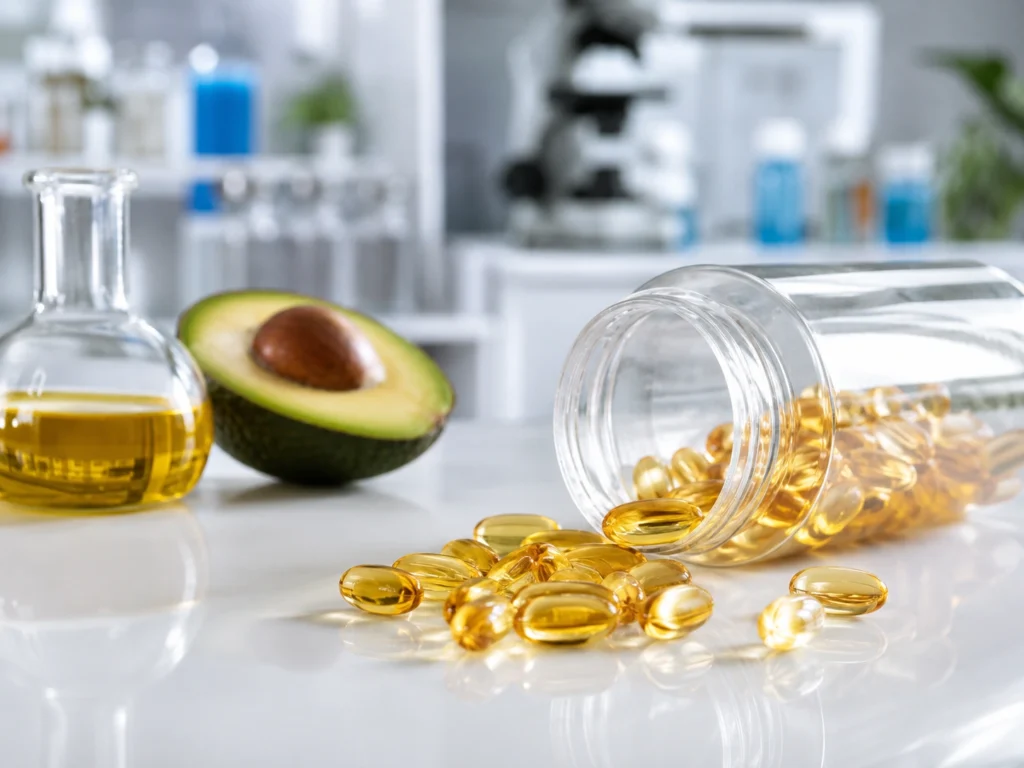
At Nutropac, one of the most common questions we hear during formulation consultations goes something like this: a brand owner wants to launch a vitamin D3 or vitamin K2 product and asks, “Can’t we just put it in a capsule?” It’s a fair question, and the short answer is yes, you technically can. The longer answer is that for fat-soluble vitamins and oil-based ingredients, the dosage form is not just a container, it’s a critical part of how well your product actually works. This article breaks down why softgels are preferred for fat-soluble vitamins and oil-based ingredients, from the biology of lipid absorption to the formulation decisions that determine shelf-life performance.
Fat-soluble vitamins, specifically vitamins A, D, E, and K, depend on a lipid environment for intestinal absorption. Most dry dosage forms don’t provide that environment. Softgels do, and that distinction has real consequences for bioavailability, stability, and product longevity. Understanding why softgels are the preferred delivery system for lipophilic vitamins helps you make better formulation decisions from the start, which means better outcomes for your customers and fewer compliance headaches for your brand.
What makes fat-soluble vitamins different from other nutrients
Not all vitamins absorb the same way, and that difference starts at the molecular level. Water-soluble vitamins like vitamin C and B-complex nutrients dissolve readily in intestinal fluid and are absorbed through enterocytes with relative ease. Fat-soluble vitamins require a fundamentally different pathway, one that depends on the presence of dietary fat before absorption can even begin. For formulators, that physiological reality is the starting point for every dosage-form decision involving lipophilic actives.
How lipophilic vitamins are absorbed in the body
Vitamins A, D, E, and K are absorbed in the small intestine through a process that begins with the formation of micelles. Bile salts secreted by the liver combine with dietary lipids to form these microscopic structures, which carry lipophilic molecules across the unstirred water layer to the intestinal wall. From there, the vitamins are taken up by enterocytes, packaged into chylomicrons, and transported through the lymphatic system before entering systemic circulation. Without adequate fat present in the gut, that entire process slows or stalls. Many studies report higher vitamin D3 absorption when the supplement is taken with a fat-containing meal, though results vary by formulation and study design, a pattern that reflects the micelle-dependent uptake mechanism described above.
Why dry dosage forms create an absorption gap
When a fat-soluble vitamin is compressed into a tablet or filled into a dry powder capsule, it has to complete several steps before absorption can begin. First, the solid matrix must disintegrate in gastric fluid. Then the vitamin must dissolve into the predominantly aqueous intestinal environment, despite having poor intrinsic water solubility. Only then can it associate with available bile micelles for transport. Each of those steps is a potential bottleneck. For consumers who take supplements on an empty stomach, that bottleneck translates to a measurable reduction in the dose that actually reaches circulation.
Why softgels are preferred for fat-soluble vitamins and oil-based ingredients
The structural and functional advantage of a softgel comes down to one core principle: the active ingredient is already in a lipid-compatible state before the consumer swallows the product. That single distinction reshapes the entire absorption picture for lipophilic vitamins, and it’s the primary reason softgels are preferred for fat-soluble vitamins and oil-based ingredients across the supplement industry.
The pre-dissolved advantage: skipping the dissolution step
In a softgel, the active ingredient is dissolved or suspended in an oil or lipid vehicle during manufacturing. When the gelatin shell ruptures in the stomach, the contents are released as a liquid oil droplet rather than a solid particle. This eliminates the dissolution bottleneck that limits dry dosage forms. The vitamin enters the small intestine already in a lipid-compatible state, positioned to interact with bile salts and form absorption-ready micelles without the multi-step disintegration process that dry forms require.
How lipid-based delivery systems support intestinal uptake
Some softgel formulations go a step further by using self-emulsifying systems that combine oil with surfactants. When these combinations meet gastrointestinal fluid, they disperse spontaneously, creating fine droplets that dramatically increase the surface area available for absorption. This is especially relevant for ingredients like CoQ10, astaxanthin, and vitamin K2, where droplet size after dispersion has been shown to influence how much of the active reaches systemic circulation for certain formulations, though the magnitude of that effect is formulation- and API-dependent. The specific improvement in bioavailability depends heavily on formulation design, which is why the quality of your manufacturing partner matters as much as the dosage form selection.
What the research actually shows
Clinical comparisons show that oil-vehicle delivery generally produces a stronger serum 25(OH)D response than powder or ethanol-based vehicles for vitamin D. Research comparing tablets, capsules, and liquid drops in healthy adults has found that liquid and encapsulated oil formulations tend to produce a greater mean rise in serum 25(OH)D than conventional tablets, though specific figures vary across studies and populations. The data also reveals an important nuance: specialized tablet systems like micellar or sucrosomial formulations can match standard softgels in certain settings. Formulation design matters as much as dosage form. For brand owners working with standard manufacturing formats, well-formulated oil-based softgels often improve fat-soluble vitamin delivery compared with conventional tablets, without requiring the complex and costly technology those advanced systems demand. That said, the degree of benefit depends on the specific formulation, and no single format guarantees superior results in every application.
Softgels and oil-based ingredients: stability and absorption through shelf life
Absorption is only half the equation. A softgel that delivers excellent bioavailability at month one but degrades significantly by month twelve isn’t a well-designed product. Stability is where softgels also outperform dry forms for oil-based actives, provided the formulation and packaging decisions are made correctly.
Oxidation and hydrolysis: the two main enemies of oil-based ingredients
Oxidation occurs when oxygen reacts with unsaturated bonds in oil molecules, producing peroxides, aldehydes, and off-odors that signal loss of potency. Hydrolysis occurs when water cleaves ester bonds in the oil, releasing free fatty acids and accelerating both fill degradation and shell weakening. Both pathways are promoted by heat, light, and humidity. The sealed gelatin shell acts as a physical barrier against oxygen and moisture ingress, one of the core structural advantages softgels hold over open-fill capsule formats. Once that barrier is compromised through leakage or poor sealing, the fill becomes far more vulnerable to both degradation pathways at once.
Antioxidant strategies and packaging choices that make a difference
Inside the fill, lipid-soluble antioxidants like tocopherols are commonly added to quench free radicals before they damage the oil. BHT and ascorbyl palmitate serve as secondary stabilizers, and chelating agents like EDTA reduce metal-catalyzed oxidation from trace impurities in raw materials. Nitrogen flushing during fill and sealing reduces headspace oxygen at the moment of greatest exposure. Amber bottles and high-barrier packaging materials are strongly recommended for oxidation-prone oils, as light and oxygen exposure are primary drivers of potency loss during storage. Brands that cut costs on packaging often see potency drift before the labeled expiration date, regardless of how well the softgel itself was formulated. The fill, the shell, and the outer packaging all have to work together as a system.
What goes inside a softgel: oil vehicles and fill excipients that drive performance
Choosing the right fill is where formulation science meets practical product development. The oil vehicle and supporting excipients inside a softgel determine not just absorption but also how stable the product remains across its shelf life. These decisions are also central to why softgels are preferred for fat-soluble vitamins and oil-based ingredients over competing formats.
Oil vehicles: MCT, fish oil, soybean oil, and when to use each
MCT oil is a popular choice for fat-soluble vitamin softgels because it offers a neutral flavor profile, strong chemical stability, and good solubilizing capacity for lipophilic actives. Soybean and sunflower oils are widely used carriers but carry higher oxidation risk due to their polyunsaturated fatty acid content. Fish oil serves a dual role in omega-3 products, functioning as both carrier and active ingredient simultaneously. Oils with higher unsaturated fatty acid content are more susceptible to oxidative degradation, which means the carrier choice has a direct impact on how well the product holds up through its labeled shelf life. Matching the oil vehicle to the active ingredient and its stability requirements is one of the first formulation decisions that shapes everything downstream, and getting it wrong creates problems that no antioxidant package can fully correct.
Emulsifiers, co-solvents, and suspending agents
Beyond the base oil, softgel fills often include surfactants like lecithin or polysorbates to improve dispersion in gastrointestinal fluid and accelerate micelle formation. Co-solvents like propylene glycol improve solubility for actives that don’t fully dissolve in oil alone. For ingredients that must be distributed uniformly throughout the fill rather than fully dissolved, suspending agents like beeswax or colloidal silica maintain content uniformity and prevent settling during storage. Each of these excipient choices involves trade-offs in texture, compatibility with the gelatin shell, and regulatory status across your target markets. Getting the excipient matrix right is a multi-variable problem, one that requires both formulation expertise and hands-on manufacturing experience to solve reliably.
Gelatin vs. vegetarian softgel shells: choosing the right option for your product
More brands now want vegan-compatible labeling without giving up the bioavailability benefits of a liquid-fill softgel format. The shell material decision is both a formulation question and a market positioning question, and the right answer depends on your target consumer and distribution channel.
Oil-fill compatibility and seal integrity
Gelatin remains the benchmark for oil-containing softgels. It forms a hermetically sealed one-piece shell that resists leakage, limits oxygen exposure, and has decades of validated performance data across a wide range of oil fills. HPMC-based vegetarian shells are increasingly available in softgel formats, but compatibility with specific oil fills varies by system and requires stability validation. Standard hard HPMC capsules are generally not suitable for liquid or oil fills without specialized sealing technology. Brands targeting vegan or halal markets should work with manufacturers who have direct experience validating plant-based shell and oil-fill combinations across different storage conditions before committing to a formula.
Shelf life performance and label claims
In humid storage conditions, HPMC shells typically outperform gelatin in moisture resistance, which matters for products distributed in warm or tropical climates. Gelatin shells can be sensitive to cross-linking reactions with certain aldehyde-producing ingredients, particularly fish oils under oxidative stress, which can slow dissolution over time without visible signs of failure. From a labeling standpoint, gelatin is animal-derived and cannot support vegetarian or vegan claims, while HPMC can, provided all other ingredients and processing aids also meet those standards. The shell material choice is ultimately a regulatory and market positioning decision as much as a formulation one, and it needs to be made with full awareness of both the science and the label requirements of your target market.
What to look for in a softgel manufacturer for oil-based formulations
Softgel manufacturing is more technically demanding than hard capsule or tablet production. Liquid fills, precise encapsulation equipment, controlled humidity environments, and strict in-process testing all have to work together to produce consistent, stable products. Choosing the wrong manufacturing partner for an oil-based supplement can undermine everything you’ve invested in formulation design.
Why GMP certification is the essential starting point
Under FDA’s 21 CFR Part 111, dietary supplement manufacturers must operate under current Good Manufacturing Practice requirements covering personnel, equipment, component testing, batch records, in-process controls, and finished product verification. For softgels specifically, the practical requirements include fill weight uniformity controls, shell integrity testing, drying condition documentation, and a complete chain of quality records from incoming raw materials through finished product release. Without that documentation trail, a brand cannot defend its label claims or respond to an FDA inquiry with confidence. GMP compliance isn’t a nice-to-have; it’s the legal baseline for selling supplements in the US market, and it should be the first criterion you apply when evaluating any softgel contract manufacturer.
How Nutropac handles oil-based softgel development end to end
Nutropac is a GMP-certified contract supplement manufacturer with end-to-end capabilities for oil-based formulations, from raw material sourcing and oil vehicle selection through encapsulation, antioxidant strategy, fill-to-shell compatibility validation, stability documentation, and finished packaging. That full-service scope matters for softgel products because the quality of every component in the system affects the final product. Working with a single manufacturing partner who manages all of those variables eliminates the quality gaps that appear when different vendors handle different parts of the process. For brands developing fat-soluble vitamin products, that coordination is where reliable, shelf-stable, bioavailable products are actually built.
The formulation decision that shapes everything downstream
Fat-soluble vitamins and oil-based actives are often better served by lipid-based dosage forms. The lipid environment that softgels provide, the pre-dissolved fill, the sealed shell, and the formulation flexibility to include antioxidants and emulsifiers, supports both how these ingredients absorb in the body and how well they hold up through shelf life. That’s not a marketing claim; it reflects the biological mechanism by which lipophilic vitamins actually reach systemic circulation. Specific formulation design can make certain advanced dry forms competitive in some applications, but for most standard supplement formats, softgels remain the most practical and well-validated choice.
For brand owners and formulators, the decision isn’t simply “softgel vs. capsule.” It’s about choosing the right oil vehicle, the right shell material for your target market, and the right antioxidant and packaging strategy to protect potency from manufacturing through the consumer’s last dose. Whether you’re launching a vitamin D3 product, a vitamin K2+D3 combination, or a full fat-soluble vitamin complex, the formulation choices you make at the start determine how well your product performs in the real world.
Those decisions compound quickly, and getting them right requires a manufacturing partner who understands how all the pieces interact. That’s why so many brand owners working with fat-soluble vitamins and oil-based ingredients find that softgels, developed with the right partner, deliver results that other formats can’t reliably match. Contact Nutropac’s formulation team to find out why softgels are preferred for fat-soluble vitamins and oil-based ingredients, and how we can put that advantage to work for your next product.