

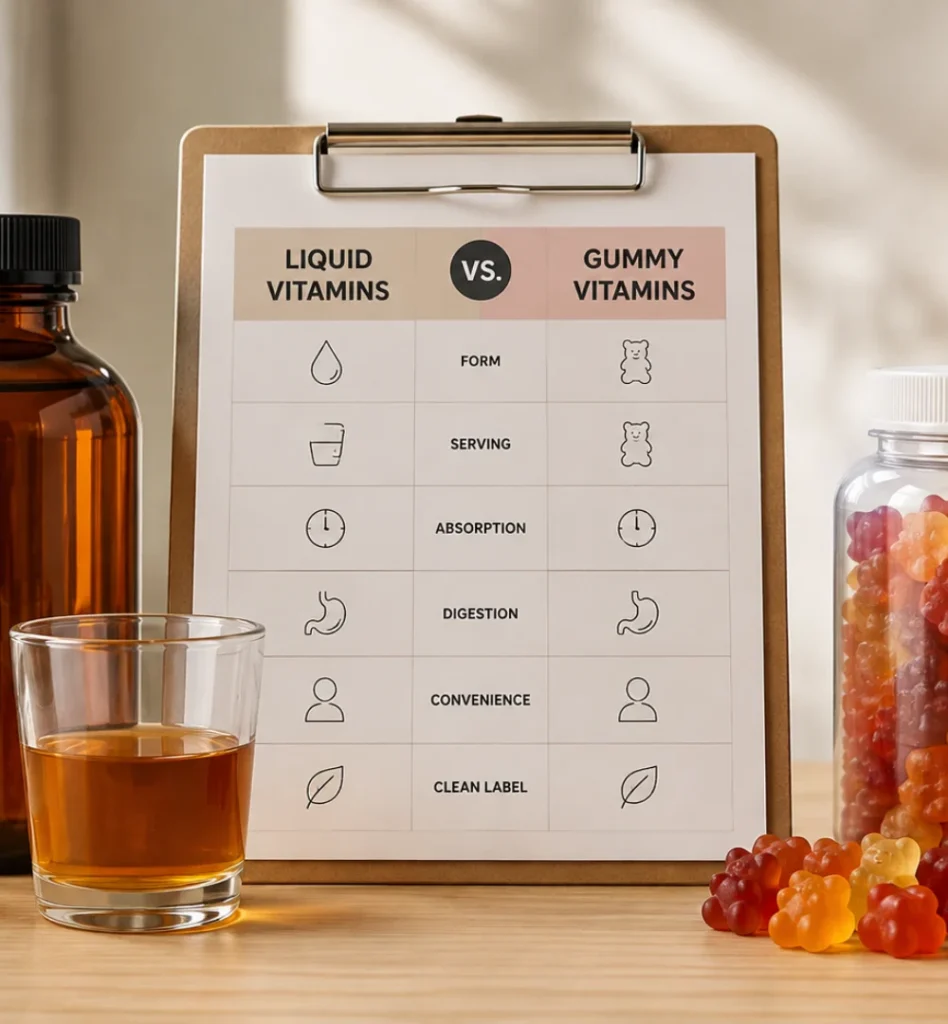
Liquid vitamins are not automatically better absorbed, and gummy vitamins are not automatically nutritionally inferior. These are two different delivery systems, each with its own limits around nutrient loading, stability, taste, serving design, packaging, and manufacturing.
For consumers, the practical rule is: compare the formula before the format. For supplement brands, the rule should be reversed: define the nutritional target before choosing the delivery system.
A useful comparison should therefore pass three tests:
- Nutritional Performance: Can the product deliver and retain the intended nutrient profile?
- Behavioral Fit: Can the intended consumer realistically use the full labeled serving?
- Commercial Performance: Can the formula, format, package, and manufacturing process remain stable and reproducible?
The better format is the one that creates the fewest unacceptable compromises across all three—not the one with the strongest marketing claim.
Are liquid vitamins actually better than gummies?
No dosage form is automatically superior simply because it is liquid or chewable. The quality of the finished product depends on what nutrients it contains, how much it delivers per serving, whether those nutrients remain within specification, how the product is used, and how well the dosage form is manufactured.
This distinction is increasingly relevant as dietary supplements move beyond conventional tablets and capsules. The USP <2800> framework for multi-ingredient dietary supplements specifically addresses multiple dosage forms, including oral liquids and chewable gels marketed as gummies, reinforcing that each format needs its own appropriate product-quality controls.
For consumers, this means the word “liquid” or “gummy” on the front of the package should not determine the decision by itself.
For brands, it means dosage form should be treated as part of product engineering rather than simply a marketing format.
Do liquid vitamins absorb better than gummies?
There is not enough direct clinical evidence to conclude that liquid multivitamins as a category are universally more bioavailable than gummy multivitamins. Absorption depends on the individual nutrient, chemical form, amount, formulation, food intake, and physiological factors rather than the dosage-form name alone.
A common marketing argument goes like this:
Liquid is already dissolved → nutrients are released faster → therefore more nutrients are absorbed.
The problem is that these are not the same biological question.
How quickly a dosage form releases a nutrient can influence absorption timing, but it does not automatically establish that the body receives a greater total amount of that nutrient.
Does faster release mean greater total absorption?
No. Faster release or an earlier peak concentration is not the same as greater total exposure. When comparing formulations, absorption timing and total bioavailability should be treated as separate measurements.
A small 2021 crossover study published in Current Developments in Nutrition compared gummy and tablet formulations containing vitamin E and folate. The researchers found similar overall exposure for the studied nutrients even though absorption timing differed for folate.
This gives us a useful distinction:
Faster is a timing claim. Better absorbed is an exposure claim.
They should not automatically be treated as synonyms.
What does the existing gummy bioavailability research actually show?
The available evidence is useful, but it is not a direct liquid-versus-gummy answer. The 2021 study involved only 19 healthy adults, compared gummies with tablets rather than liquids, and was industry funded, so it should be interpreted within those limitations.
Its value is not that it proves gummies and liquids behave identically. Instead, it demonstrates why simple assumptions such as “faster release must mean more total absorption” require stronger evidence than format-level marketing claims usually provide.
For a liquid supplement brand, this creates an important claims discipline:
Do not build a universal superiority claim around the dosage form unless the evidence actually supports the specific nutrient, formula, and comparison being made.
Can gummy vitamins deliver nutrients effectively?
Yes, but a gummy has to perform as both a nutrient-delivery system and a structured physical matrix. Active ingredients need to coexist with the components and physical properties required to maintain an acceptable gummy through manufacturing and shelf life.
A 2024 study published in AAPS PharmSciTech examined prototype gummies using quality attributes including hardness, chewiness, adhesiveness, moisture content, weight uniformity, rupture force, and pH.
That research highlights an important product-development reality:
A gummy is not empty space waiting to be filled with vitamins.
The dosage form itself has structural requirements that share formulation space with the active ingredients.
What does a gummy formula need besides vitamins and minerals?
The nutrients have to coexist with the system that makes the product a gummy. Depending on the formulation, that system can involve gelling agents, water, sweeteners, acids, flavors, colors, and other formulation components.
These components influence characteristics such as:
- Texture
- Moisture
- Chewiness
- Stickiness
- Flavor
- pH
- Processing behavior
- Shelf-life performance
This is why product developers should not design a large Supplement Facts panel first and assume the complete nutrient system will fit naturally into a gummy afterward.
Every milligram of active material has to share the dosage form with the system that makes the gummy a gummy.
Why can higher nutrient loads become difficult in gummies?
Higher active loads can increase mass and create additional challenges around taste, texture, stability, processing, and serving count. This does not mean high-load gummy formulations are impossible; it means the delivery system needs to be considered while the nutrient profile is being designed.
Minerals can be particularly relevant because they may add substantial material mass and introduce difficult sensory characteristics.
University Hospitals notes that nutrients such as calcium, magnesium, iron, and some higher-dose vitamins can present practical formulation challenges in gummies.
A brand should therefore ask:
- How much active material is required per serving?
- How many gummies would that require?
- Can the intended taste and texture still be achieved?
- Can the nutrient remain stable in the matrix?
- Will consumers realistically take the full serving?
The useful question is not simply whether an ingredient can be added.
It is whether the complete product still works after it is added.
Can liquid vitamins carry more nutrients than gummies?
Liquids can offer greater flexibility for some nutrient systems, but they are not unlimited containers for active ingredients. Higher concentrations can create their own constraints involving solubility, pH, taste, serving volume, precipitation, oxidation, viscosity, and physical stability.
This is where many Liquid vs Gummy comparisons become unbalanced.
They correctly identify the structural limitations of gummies but then treat liquids as though those limitations disappear rather than change form.
In reality, liquid formulation creates a different engineering problem.
What happens when a liquid multivitamin becomes too concentrated?
A stronger-looking ingredient list can produce a weaker product design if the liquid system cannot comfortably support it. Increasing nutrient load can change the formula’s taste, appearance, serving volume, pH, solubility, and long-term behavior.
Potential consequences can include:
- Precipitation or sedimentation
- Strong metallic or bitter notes
- Increased serving volume
- Color changes
- Higher viscosity
- Ingredient interactions
- Greater oxidation sensitivity
- Additional stabilization requirements
A study of vitamin D3 in aqueous systems published in Pharmaceutics demonstrated that temperature, light, oxygen, pH, concentration, and other environmental factors can influence vitamin stability in liquid systems.
The lesson is broader than vitamin D3 itself:
Putting a nutrient into a liquid does not eliminate the need to engineer the environment around it.
Which format is more stable: liquids or gummies?
Neither liquid vitamins nor gummies are universally more stable. Stability depends on the nutrient, formulation, manufacturing process, packaging, storage conditions, and intended shelf life.
The two dosage forms simply create different failure modes.
Gummies do not own the stability problem. Liquids do not escape it. They fail differently.
What can go wrong with gummy vitamin stability?
A gummy has to maintain both its active ingredients and its physical matrix. Moisture changes, temperature, texture changes, ingredient interactions, processing conditions, and nutrient degradation can all influence product quality.
The 2024 gummy-formulation research demonstrates why moisture, texture, pH, and physical uniformity deserve attention alongside active-ingredient content.
That means a gummy can change in commercially meaningful ways even before a consumer would describe the product as obviously spoiled.
What does vitamin C gummy research tell us about stability?
An unstable nutrient can require deliberate stabilization within a gummy system. Recent vitamin C research provides a good example of why formulation technology matters.
A 2026 study published in ACS Omega examined a stabilization approach developed specifically because vitamin C can undergo degradation during gummy processing and storage.
The correct conclusion is not:
“Vitamin C should not be put in gummies.”
It is:
“A sensitive nutrient does not become stable simply because the finished format is convenient.”
Formulation engineering still matters.
What can go wrong with liquid vitamin stability?
Liquid nutrients can be affected by light, oxygen, pH, temperature, ingredient interactions, concentration, and the chemical environment of the formula. Depending on the product, instability may appear as nutrient degradation, precipitation, color change, flavor deterioration, or other physical changes.
The vitamin D3 stability research found substantial effects from environmental variables in aqueous formulations, demonstrating why liquid nutrient stability has to be established for the actual formulation rather than inferred from the dosage form.
Liquid therefore should not be interpreted as:
“Already dissolved, so the formulation problem is solved.”
Dissolving the ingredient is only one part of building a stable commercial product.
Can packaging change vitamin stability in a liquid product?
Yes. Packaging can become part of the nutrient-stability system rather than simply a branding decision. The material, oxygen exposure, light protection, closure system, processing method, and storage environment can all influence the conditions experienced by the liquid.
A 2026 study examining vitamin C and vitamin B1 in ready-to-drink nutritional products found that processing and packaging systems influenced vitamin retention during storage.
For supplement brands, this creates an important development rule:
Packaging should be selected with the formula—not after the formula.
A bottle that looks premium but creates poor light, oxygen, filling, or storage conditions is not necessarily premium product design.
Do liquid vitamins lose potency after opening?
Opening a multi-serving liquid can change the environment the product experiences, but there is no universal rule that all liquid vitamins lose potency after a fixed number of days. In-use stability depends on the nutrient system, formula, bottle, closure, consumer handling, and storage instructions.
Opening a bottle can potentially introduce changes in:
- Air exposure
- Light exposure
- Temperature variation
- Consumer handling
- Repeated opening and closing
However, those factors do not justify applying the same after-opening shelf-life claim to every liquid vitamin.
Consumers should follow the storage and use instructions for the specific product rather than relying on generalized internet rules.
Brands should consider in-use conditions during product development when they are relevant to the finished formula.
Are gummies easier to take consistently?
Gummies can provide an attractive and familiar serving experience, but it would be too strong to claim that gummy vitamins universally create better supplement adherence. Palatability can influence acceptability, but supplement-specific adherence depends on more than taste alone.
This is where many format comparisons confuse preference with outcome.
A consumer may strongly prefer gummies, while another may dislike chewing multiple pieces every day and prefer a measured liquid serving.
The correct question is therefore:
“Can this intended consumer realistically follow the complete labeled serving?”
Does taste really affect whether people use a supplement?
Taste can influence acceptability, but the strength of that relationship should be described carefully. Evidence from medicines shows that poor palatability can create real barriers to product acceptance, although that evidence should not automatically be treated as a clinical study of adult gummy-vitamin adherence.
A 2025 scoping review examining pediatric medicines found that poor taste was repeatedly associated with acceptability problems and, in some studies, medication-adherence difficulties.
That supports a reasonable product-design principle:
Palatability matters because people have to actually use the product.
It does not support the stronger claim:
“Gummies automatically produce better adherence.”
Is the easiest format to take always the best one?
No. Ease of use is only one dimension of a supplement product. A convenient product that cannot deliver its intended nutrient profile reliably is not automatically better, just as a technically excellent formula that its target consumer repeatedly avoids has limited practical value.
This creates two tests:
Nutritional Performance
Can the formulation deliver what the product is intended to provide?
Behavioral Fit
Will the intended user realistically take the labeled serving?
Neither should be ignored.
What is the Three-Performance Test for comparing liquid vitamins and gummies?

A better format decision should pass three tests: Nutritional Performance, Behavioral Fit, and Commercial Performance. A dosage form should not be judged successful simply because it performs strongly in one area.
This framework works for both consumers and brands because it connects what the product contains, how people use it, and whether the finished product can actually remain stable and reproducible.
1. Does the format deliver the intended nutrition?
The product needs to provide the intended nutrients and amounts while maintaining them within the required product specification. That is Nutritional Performance.
This requires more than asking:
“Can this ingredient be added?”
Brands should ask:
- Can the intended amount fit into the serving?
- Can the nutrient remain stable?
- Will the format force meaningful formulation compromises?
- Can the finished product consistently meet its specification?
2. Does the serving fit the consumer’s routine?
The full serving needs to make sense in real-world use. That is Behavioral Fit.
For a gummy, the consumer may need to chew several pieces. For a liquid, the consumer may need to measure a specific volume.
Neither is inherently more convenient.
The better design depends on:
- Target consumer
- Number of gummies
- Liquid serving volume
- Frequency of use
- Measurement requirements
- Portability
- Sensory preference
3. Can the product remain stable and reproducible?
A commercially successful product needs to work beyond the first attractive sample. That is Commercial Performance.
The formula needs to coexist with:
- Commercial processing
- Raw-material sourcing
- Testing
- Packaging
- Storage
- Distribution
- Repeat production
This is where dosage-form selection becomes especially important for supplement brands.
A gummy that tastes excellent in development but cannot maintain the intended texture or nutrient profile is not commercially solved.
A liquid that performs well in a bench sample but develops precipitation or unacceptable nutrient loss in the finished package is not commercially solved either.
The product is only solved when formula, format, package, and process work together.
How do liquid vitamins and gummies compare technically?
The table below compares the main development questions rather than declaring a universal winner. Actual performance depends on the specific formula, nutrient system, serving size, process, and package.
| Question | Liquid Vitamins | Gummies |
|---|---|---|
| Does the format guarantee better absorption? | No | No |
| Primary physical system | Liquid / aqueous or other fluid matrix | Structured chewable gel matrix |
| Main nutrient-loading constraints | Solubility, concentration, serving volume, taste, viscosity | Matrix capacity, gummy size, texture, taste, serving count |
| Typical stability questions | pH, oxidation, light, precipitation, ingredient interaction, packaging | Moisture, texture, heat, matrix interaction, nutrient degradation |
| Serving method | Measured liquid volume | Defined number of gummies |
| Palatability challenge | Active taste must be managed within a liquid system | Active taste must coexist with gummy taste and texture requirements |
| Packaging role | May influence light, oxygen, storage, and nutrient stability | May influence humidity exposure and physical gummy quality |
| Best format | Depends on the product brief | Depends on the product brief |
What should consumers compare before choosing liquid vitamins or gummies?
Consumers should compare the complete formula rather than assuming dosage form determines nutritional quality. Serving size, nutrient amounts, ingredient forms, other ingredients, directions, and storage requirements provide more useful information than a format claim on the front of the package.
The NIH Office of Dietary Supplements notes that there is no standard multivitamin/mineral formula and manufacturers determine which nutrients and amounts their products contain.
That means two gummies can differ substantially from each other, just as two liquid multivitamins can.
Before comparing formats, check:
- Serving size
- Nutrients included
- Amounts per serving
- Nutrient forms where relevant
- Other ingredients
- Sweeteners
- Directions for use
- Storage requirements
Why should you compare the full serving rather than one gummy or one sip?
Supplement Facts values relate to the labeled serving, not an arbitrary individual piece or sip. One product may require several gummies, while another may require a measured liquid volume.
A fair comparison therefore uses:
Full gummy serving vs full liquid serving
rather than:
One gummy vs one teaspoon
unless those happen to be the actual labeled servings.
Does the formula matter more than whether the product is liquid or gummy?
Often, yes. Because multivitamins are not standardized into one universal nutrient formula, the nutritional difference between two products can be much larger than the difference implied by their delivery systems.
This leads to a useful consumer rule:
Read the Supplement Facts before making conclusions from the dosage form.
Are gummies always higher in sugar than liquid vitamins?
No. Sweetener choice is formulation-specific rather than format-specific. Some gummies contain conventional sugars, while others use alternative sweetening systems; liquid supplements can also contain sugars, alternative sweeteners, flavors, acids, or taste-masking systems.
Brands should not treat:
Gummy = sugar
and:
Liquid = sugar-free
as automatic assumptions.
Consumers should evaluate the actual ingredient list and applicable nutrition information.
Which format works better for a complex multivitamin formula?
There is no universal winner for complex multivitamins. The better dosage form is the one that accommodates the required nutrient profile while maintaining acceptable stability, sensory experience, serving size, manufacturing feasibility, and consumer usability.
For example, a complex gummy formula may become constrained by:
- Gummy size
- Number of pieces per serving
- Matrix requirements
- Active taste
- Texture
- Moisture and stability
A complex liquid formula may instead become constrained by:
- Solubility
- Serving volume
- pH
- Bitterness or metallic taste
- Oxidation
- Precipitation
- Packaging requirements
Different constraints do not imply different quality levels.
They mean the format decision should follow the product requirements.
What should a supplement brand decide before choosing liquid or gummy?
Define the nutritional target before selecting the delivery system. Starting with “we want a gummy” or “we want a liquid” can force unnecessary compromises into the formula.
A stronger development sequence is:
Target Consumer → Nutritional Objective → Nutrient Profile → Serving Requirement → Format Feasibility → Sensory Development → Stability → Packaging → Commercial Production
This changes the question from:
“We want to launch a gummy. What can we fit into it?”
to:
“This is what our product needs to deliver. Which format allows us to do that with the fewest unacceptable compromises?”
That is a much stronger starting point for product development.
When should a brand consider liquid vitamins?
Liquid deserves serious evaluation when the intended nutrient system, serving design, and consumer experience fit a liquid product without unacceptable solubility, taste, stability, or packaging compromises. The format should solve the product brief rather than become the product brief.
Liquid may deserve further consideration when:
- A measured serving fits the intended consumer.
- The target nutrient combination can remain suitably incorporated.
- The required serving volume remains practical.
- The sensory profile can be managed.
- The intended package supports product stability.
- The liquid experience supports the brand proposition.
None of these conditions means liquid is universally better.
They mean the product requirements align with what a liquid delivery system can provide.
When should a brand consider gummies?
Gummies deserve consideration when a chewable serving meaningfully supports the intended consumer experience and the required nutrient load can fit the matrix without unacceptable formulation compromises. Their value should come from product fit rather than trend alone.
Gummies may deserve further evaluation when:
- A chewable serving strongly fits the target audience.
- The active load fits a practical number and size of gummies.
- The intended nutrient system can remain stable.
- Taste and texture can remain acceptable.
- The matrix supports the desired product positioning.
- The commercial manufacturing model is viable.
The important question is not whether gummies are currently popular.
It is whether a gummy system is an efficient way to deliver this specific product.
Which format fits your product brief?
This decision matrix is intended to identify which format deserves further development work—not to declare an automatic winner.
| Product Requirement | Evaluate Liquid When… | Evaluate Gummy When… |
|---|---|---|
| Complex nutrient profile | The target formula can remain incorporated, stable, and palatable at a practical serving volume | The target nutrient load fits a practical gummy size and serving count |
| Serving experience | A measured liquid serving fits the consumer routine | A fixed chewable serving fits the consumer routine |
| Strong active taste | A suitable liquid flavor and masking system can be developed | The gummy system can manage the active taste while maintaining texture |
| Consumer avoids pills | Drinking or dispensing is preferred | Chewing is preferred |
| Shelf-life sensitivity | A suitable liquid stabilization and packaging system can be established | A suitable matrix and moisture-management system can be established |
| Formula differentiation | The liquid system enables the intended nutrient or serving design | The gummy system enables the intended sensory or product experience |
| Portability | A practical portable or single-serve liquid format is available | A portable chewable serving supports the product concept |
| Commercial production | Formula, filling, packaging, testing, and repeat production are viable | Matrix, forming, coating, packaging, testing, and repeat production are viable |
What should brands ask a manufacturer before choosing the format?
A manufacturer should explain what each dosage form does to the specific product brief rather than simply confirming that both formats are available. The most valuable conversation is about trade-offs.
Ask:
- Can the full target nutrient profile fit this format?
- What formulation compromises would be required?
- What would one complete serving look like?
- Which ingredients create the greatest stability challenge?
- Which ingredients create the greatest sensory challenge?
- How will stability be evaluated?
- How does packaging interact with the product?
- Which raw materials create MOQ constraints?
- What changes when the product moves from development sample to commercial scale?
- Can the same product be reproduced reliably on future orders?
The least useful manufacturer answer is:
“Yes, we can make either.”
The more useful answer is:
“Here is what your formulation would require in each format, these are the trade-offs, and these are the technical risks we would need to resolve.”
What is the final rule for comparing liquid vitamins and gummies?
Do not rank supplement dosage forms using assumptions such as “liquid means better absorbed” or “gummies are less serious supplements.” Judge the finished product by what it can deliver, how well it maintains that performance, whether the intended consumer can use it properly, and whether it can be reproduced commercially.
For consumers:
Compare the formula before the format.
Read the full serving, nutrient profile, ingredient information, and directions before allowing the delivery system to determine your conclusion.
For supplement brands:
Define the nutritional target before choosing the delivery system.
Do not select a gummy because the category is popular and then discover what nutrients fit. Do not select liquid because “better absorption” creates an attractive marketing story and then design evidence around the claim.
Instead, ask:
“What does this product need to deliver, for whom, and which delivery system creates the fewest unacceptable compromises?”
Then apply the Three-Performance Test:
- Nutritional Performance: Can the formula deliver and retain its intended nutrition?
- Behavioral Fit: Can the target user realistically follow the serving?
- Commercial Performance: Can the product remain stable, manufacturable, and reproducible?
The better format is not the one with the strongest format-level claim. It is the one that creates the best complete product.
Frequently Asked Questions
Are liquid vitamins absorbed better than gummies?
There is not enough direct evidence to conclude that liquid multivitamins are universally better absorbed than gummies as a category. Absorption depends on the nutrient, chemical form, dose, formulation, food intake, and individual physiology, and faster release should not automatically be interpreted as greater total bioavailability.
Are gummy vitamins effective?
Gummies can function as effective nutrient-delivery systems when the formula provides appropriate nutrient amounts and maintains the required quality through shelf life. Their gummy matrix creates specific constraints involving nutrient load, texture, moisture, processing, and stability, but those constraints do not make the format inherently ineffective.
Do liquid vitamins lose potency faster than gummies?
No universal comparison can be made because stability is nutrient-, formulation-, package-, and storage-specific. Gummies and liquids both face stability challenges, but the relevant failure modes and stabilization strategies are different.
Which format should a supplement brand choose?
Brands should choose the format that best supports the required nutrient profile, stability, sensory experience, consumer behavior, packaging, and commercial manufacturing system. The dosage form should be selected after the product brief is defined rather than because liquid or gummy happens to be more marketable at the moment.