

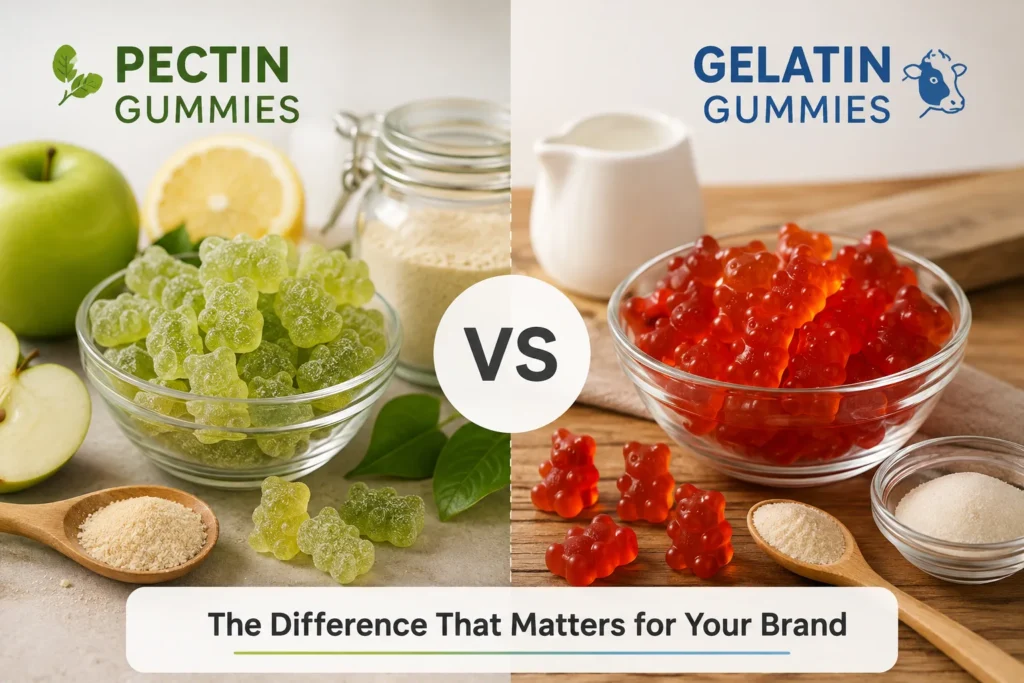
When supplement brand managers start planning a gummy product, most attention goes toward the active ingredients, the flavor profile, and the packaging. The gummy base itself, whether pectin or gelatin, often gets treated like a background detail. That is a mistake. The choice between pectin vs gelatin gummy supplements shapes everything a health brand cares about downstream: who can buy your product, how long it lasts on a shelf, what your label can say, and how much you will spend per kilogram of finished goods.
At Nutropac, we run both pectin and gelatin gummy formulations and help brands work through this decision before they ever commit to a pilot batch. The conversation always covers the same six dimensions, and this article walks through all of them. By the end, you will have a clear enough picture to know which gelling agent fits your product and what your next formulation steps should look like.
How these two gelling agents behave in a formula
Texture and mouthfeel: a fundamental difference in chew
Pectin produces a firm, clean bite with very little stretch, closer to a fruit pâté than a traditional gummy. Gelatin produces the bouncy, elastic chew consumers recognize from gummy bears: it stretches before it breaks and has that soft, melt-in-mouth quality that dominates the mainstream supplement aisle. Neither texture is objectively better; the right one depends entirely on your category and your target consumer. A pediatric multivitamin brand and a clinical nutraceutical company have completely different expectations from their customers, and the gummy base should reflect that.
Setting mechanism and what it means for your production line
Pectin sets through a combination of high soluble solids, low pH, and elevated temperature. High-methoxyl (HM) pectin systems are typically deposited hot at around 180, 190°F, at 80, 82 Brix, and a pH in the range of 3.0, 3.3. Low-methoxyl (LM) pectin takes a different path: it gels through calcium pectinization, requiring roughly 10, 30 mg of calcium per gram of pectin, and it works across a much broader pH range of 2.8, 6.5. Gelatin behaves differently at every stage: it dissolves in hot liquid and sets as the system cools, forming a protein network that is more forgiving on pH but far more sensitive to heat during storage and transit. That difference in setting mechanism directly affects what you need from a production line, which we cover in section five.
Pectin vs Gelatin Gummy Supplements: Shelf Life and Heat Stability
How each base performs under accelerated conditions
Heat stability is the dimension that separates these two gummy gelling agents most decisively for brands targeting warm climates, e-commerce channels without cold chain controls, or extended shelf-life claims. Pectin gummies typically hold structure at 40°C/75% RH, the standard ICH accelerated condition, long enough to generate credible 12, 24 month shelf-life projections. The industry rule of thumb is that three months in an accelerated chamber approximates 12 months real-time, and six months approximates 24 months, though results depend heavily on the complete formulation, packaging, and water activity. Gelatin softens and loses structure near 35°C, a threshold that can vary with the gelatin’s bloom strength and the formula’s water activity, which means the accelerated chamber can trigger structural failure before you have usable stability data. If your product is headed to a retailer in a warm-weather market, or into a direct-to-consumer shipping box in July, that difference matters enormously.
Failure modes: how each base degrades differently
Pectin gummies fail through hardening, surface crystallization, and brittleness when moisture conditions shift. Gelatin gummies fail through softening, puddling, shape collapse, and sticking, typically when temperature rises. Both failure modes are real, but they occur under different conditions and at different rates, which means your packaging choice, your storage recommendations, and your target markets need to be matched to the base you are using. For heat-sensitive actives like Vitamin C and Vitamin D, the matrix’s structural integrity through storage stress directly affects potency retention. A pectin matrix that survives accelerated testing intact gives those actives a more stable environment over the product’s shelf life.
Ingredient compatibility and formulation constraints
pH sensitivity, calcium requirements, and what each base tolerates
HM pectin’s dependency on low pH and high sugar solids creates real guardrails. If your formula requires a pH above 3.5, or if your sugar content needs to be lower for a reduced-sugar positioning, HM pectin becomes difficult to work with. LM pectin gives you more room on both variables because the gelling mechanism runs on calcium rather than acidity. The tradeoff is tighter calcium control: too little and the gel stays soft or sets unevenly; too much and it turns rubbery, brittle, or prone to syneresis. Gelatin is more pH-tolerant across the board, but it has its own sensitivities to high concentrations of certain minerals and proteolytic enzymes, which can disrupt the protein network.
How common gummy actives interact with each base
For Vitamin D, pectin has strong published evidence for sustained release and storage stability in simulated gastrointestinal conditions. One pectin, Vitamin D nanocomplex study documented excellent stability in simulated gastric fluid and controlled release in intestinal fluid, supporting its use as a protective matrix. Gelatin-based coacervates can also protect Vitamin D and improve thermal stability, though they remain more temperature-sensitive overall. For Vitamin C, the primary role of either matrix is physical protection from oxygen, moisture, heat, and pH stress rather than a direct chemical interaction with the vitamin itself, an informed formulation inference supported by general encapsulation principles rather than gummy-specific Vitamin C stability trials.
Probiotics present a more nuanced picture. Both bases have been studied as encapsulation materials that may buffer acid exposure and support delayed release, though the evidence for improved intestinal viability in finished gummy formats specifically is limited, and any viability benefit should be verified through product-specific stability testing. Iron compatibility is primarily a formulation and dispersion issue in either system, not a bioavailability question, and both bases can keep iron distributed evenly through the formula without strong evidence favoring one over the other.
Consumer positioning and what your label has to say
The vegan divide: a market signal worth taking seriously
Gelatin is derived from animal collagen, most commonly pork or bovine sources. That single fact excludes a meaningful and growing segment of buyers: vegans, vegetarians, halal and kosher consumers, and clean-label-conscious shoppers who read ingredient panels. Pectin is plant-derived, typically from citrus peel or apple pomace, which makes it the default choice for any brand positioning around plant-based or vegan values. Market data supports taking this seriously: in 2025, plant-based gummies held roughly 32% of the US gummy supplement market and were growing at a projected 10%+ CAGR through 2031, while gelatin-based gummies still dominated at approximately 68% (estimates vary across market reports by definition and methodology). Plant-based is the faster-growing segment, and a brand entering the market now is building for where consumer expectations are headed.
Label claims, allergen disclosures, and regulatory considerations
The FDA does not maintain a formal regulatory definition for “vegan” or “plant-based” as label claims on dietary supplements, but the requirement that all label claims be truthful and not misleading applies fully. If your gummy contains gelatin, a vegan claim is inconsistent with your ingredient profile and creates regulatory and consumer trust exposure. Pectin supports a vegan or plant-based claim, but the rest of your formula and any processing aids still need to align. Halal and kosher certification for gelatin-based products requires sourcing from certified-compliant suppliers and third-party verification, which adds complexity and cost that many brands underestimate at the formulation stage. These decisions need to be made before the spec sheet is finalized, not after you have already placed a raw material order.
Manufacturing process differences and what they cost you
What each base demands on the production floor
Pectin gummy production requires tighter process control at the most critical stages. pH adjustment and depositing are particularly sensitive: the mass can gel rapidly once the pH and solids conditions converge, which leaves a narrow processing window. A pectin line typically needs high-speed precision depositors, strict Brix monitoring, and tight deposit temperature management to hit the 80, 82 Brix and 3.0, 3.3 pH targets consistently. Gelatin production is more forgiving in process tolerance, but it requires careful temperature management throughout, the batch must stay warm enough to remain fluid during depositing and then be cooled properly to set without sticking or deforming. Not every contract gummy manufacturer handles both gummy gelling agents equally well, and the equipment and process expertise required for high-quality pectin gummies is more demanding than for standard gelatin production.
Raw material cost and what it means at scale
Food-grade pectin runs approximately $9, 15/kg at 2025, 2026 wholesale pricing, with specialty or smaller-lot orders ranging higher. Food-grade gelatin sits around $3, 8/kg for standard bulk supply, making pectin roughly 2, 3 times more expensive per kilogram on a raw material basis. In a gummy formula where the gelling agent is a meaningful line in the bill of materials, that premium adds up as you scale production volume. The cost difference is real and should be planned for, but it does not automatically make gelatin the better choice. For a brand competing in premium retail, plant-based, or international markets where heat stability is a non-negotiable, the stability performance and consumer positioning advantages of pectin can fully justify the higher raw material cost.
Choosing the right gummy base for your brand
When pectin is the stronger choice for health brands
Pectin is the clearer choice in several distinct scenarios. If your target consumer is vegan or plant-based, gelatin is simply off the table. If your product will be sold in warm climates, via direct-to-consumer channels without cold chain controls, or in international markets where temperature management across the supply chain is inconsistent, pectin’s thermal stability is not a premium, it is a requirement. If your actives include heat-sensitive compounds that benefit from a thermally stable matrix, or if your brand positioning centers on clean-label sourcing and ingredient transparency, the formulation logic points to pectin. Consider pectin your primary option when any of the following apply:
- Your target consumer identifies as vegan or plant-based
- Your distribution includes warm climates, DTC shipping, or international markets with variable cold chain management
- You needcredible accelerated stability datasupporting a 12, 24 month shelf-life claim
- Your formula includes heat-sensitive actives that benefit from a thermally stable matrix
- Your brand positioning centers on clean-label sourcing, transparency, and ingredient integrity
In any of these situations, trying to make gelatin work around those constraints will cost more in stability testing, failed batches, or consumer trust than the raw material savings justify.
When gelatin still makes sense
Gelatin remains a practical, cost-effective choice for brands targeting mainstream US retail where plant-based positioning is not the primary purchase driver. It works well for products stored and sold in temperature-controlled environments, for formulations where the classic elastic gummy chew experience is central to consumer appeal, and for brands with tighter raw material budgets that need to protect margin. Gelatin gummies still represent the majority of the supplement gummy category by volume, accounting for around 68% of the US market in 2025. That is not a category in decline, it is a different target audience and a different performance profile, and for the right product, it remains the more straightforward and cost-efficient path.
Getting to a confident formulation decision
This decision rarely needs to be made on specification documents and market data alone. A pilot run and a focused stability study will answer the questions that no theoretical comparison can close. Working with a gummy contract manufacturer experienced in both bases shortens that path considerably: a formulator who has run both pectin and gelatin systems across multiple active categories can flag compatibility issues, process risks, and stability concerns before they show up in a batch failure. Nutropac runs both pectin and gelatin gummy formulations, offers pilot batch programs, and helps brands match their gummy base to their target market and active ingredient profile before committing to full production. That front-end investment in the formulation decision pays off in fewer reformulations and faster time to market.
The decision is strategic, not just technical
Pectin and gelatin are not interchangeable. They are two different formulation tools with different textures, different thermal behaviors, different raw material costs, and different consumer signals attached to them. When evaluating pectin vs gelatin gummy supplements for your health brand, the right choice comes down to five factors working in combination: the texture expectation your target consumer brings to the product, the heat stability requirements of your supply chain, the consumer positioning your brand is building, the active ingredients you are delivering, and the budget reality of your manufacturing program.
For brands entering the gummy supplement category now, the formulation base is an early strategic decision, not a back-end technical detail. Get it wrong and you are looking at reformulation costs, stability failures, or a label that cannot support the claims your marketing needs. The most valuable next step is a conversation with a manufacturer who has run both pectin and gelatin gummy supplements and can pressure-test your formula against real production and stability data. Start there before you finalize your product spec.